Türkiye
Things to do in Antalya
69 places69 stories3 routes
Sightlore has 69 places to explore in Antalya, and 69 of them come with a 60-second story in 5 languages. Point your camera at a landmark to learn its name and story, and earn points and badges at the places you actually visit.
Antalya's must-sees
The city's most important places. In the app you see how many you've visited and earn a badge when you've seen them all.
- 1

Eurymedon Bridge (Aspendos)
The Eurymedon Bridge was a late Roman bridge over the river Eurymedon (modern Köprüçay), near Aspendos, in Pamphylia in southern Anatolia.
- 2

Kaleici Museum
The Kaleiçi Museum is housed in a restored Ottoman mansion and the former Greek Orthodox Church of St George in Antalya's old town. It displays Turkish tiles, ceramics and a reconstruction of traditional Antalya home life.
- 3

Perge
Perga or Perge was originally an ancient Lycian settlement that later became a Greek city in Pamphylia.
- 4

St. Nicholas Church, Demre
St. Nicholas Church is an ancient East Roman basilica church in the ancient city of Myra which had been in use until the local Greeks had to leave in 1922, and is now a museum located in modern Demre, Antalya Province, Turkey.
- 5

Patara
Patara was an ancient and flourishing maritime and commercial city that was for a period the capital of Lycia. The site is located on the Turkish coast near to the village of Gelemiş, in Antalya Province.
- 6

Hadrian's Gate
Hadrian's Gate is a memorial gate located in Antalya, Turkey, which was built in the name of the Roman emperor Hadrian, who visited the city in 130 CE.
- 7

Andriaca
Andriake or Andriaca was an ancient city and the port of the ancient town of Myra in Lycia. It is in the modern Demre district of Antalya Province, in south-western Turkey. The site has a museum.
- 8

Temple of Apollo
The Temple of Apollo is a Roman temple built around 150 A.D. during the Pax Romana era in the ancient Pamphylian town of Side, in southern Turkey on the Mediterranean Sea coast and dedicated to Apollo, the Greek and Roman god of music, harmony and light, inter alia.
- 9

Myra
Myra was a city in Lycia in what is today Turkey. The city was probably founded by Lycians, and was located on the river Myros, in the fertile alluvial plain between the Massikytos range and the Aegean Sea.
- 10

Kaputaş Beach
Kaputaş Beach is a small beach between Kaş and Kalkan in southwestern Turkey.
Discovery routes in Antalya
Visit the stops in any order and tap "Check in" at each one; finish the route to earn points and its own badge.
Kaleiçi Walk
From the Fluted Minaret to Hadrian's Gate, through narrow lanes to Hıdırlık Tower and Karaalioğlu Park at sunset.
Ancient Cities of Pamphylia
A day trip by car: the colonnaded streets of Perge, Aspendos with the world's best-preserved ancient theatre, a Seljuk bridge, seaside Side and its Temple of Apollo, and finally the Manavgat Waterfall.
Lycian Coast
A two-day road trip: the rock tombs of Myra and the Church of St Nicholas, the port of Andriake, the ancient theatre in Kaş, Kaputaş cove, Patara and Xanthos, capital of Lycia.
Places to visit
Historic sites

Hidirlik Tower
Hıdırlık Tower is a landmark tower of tawny stone in Antalya, Turkey, where Kaleiçi meets Karaalioğlu Park.
Perge
Perga or Perge was originally an ancient Lycian settlement that later became a Greek city in Pamphylia.

Roman Theatre of Aspendos
The Roman theatre of Aspendos is a Roman theatre in the ancient city of Aspendos in Turkey. It was built in the 2nd century and is one of the best preserved ancient theaters of the Greco-Roman world.
Eurymedon Bridge (Aspendos)
The Eurymedon Bridge was a late Roman bridge over the river Eurymedon (modern Köprüçay), near Aspendos, in Pamphylia in southern Anatolia.

Side
Side (formerly Selimiye) is a city on the southern Mediterranean coast of Turkey. It includes the modern resort town and the ruins of the ancient city of Side, one of the best-known classical sites in the country.
Temple of Apollo
The Temple of Apollo is a Roman temple built around 150 A.D. during the Pax Romana era in the ancient Pamphylian town of Side, in southern Turkey on the Mediterranean Sea coast and dedicated to Apollo, the Greek and Roman god of music, harmony and light, inter alia.
Myra
Myra was a city in Lycia in what is today Turkey. The city was probably founded by Lycians, and was located on the river Myros, in the fertile alluvial plain between the Massikytos range and the Aegean Sea.
Andriaca
Andriake or Andriaca was an ancient city and the port of the ancient town of Myra in Lycia. It is in the modern Demre district of Antalya Province, in south-western Turkey. The site has a museum.

Antiphellus
Antiphellus or Antiphellos, known originally as Habesos, was an ancient coastal city in Lycia. The earliest occurrence of its Greek name is on a 4th-century-BCE inscription.
Patara
Patara was an ancient and flourishing maritime and commercial city that was for a period the capital of Lycia. The site is located on the Turkish coast near to the village of Gelemiş, in Antalya Province.

Xanthos
Xanthos or Xanthus, also referred to by scholars as Arna, its Lycian name, was an ancient city near the present-day village of Kınık, in Antalya Province, Turkey. The ruins are located on a hill on the left bank of the River Xanthos.

Alanya Castle
Alanya Castle (Alanya Kalesi) is a medieval castle in the southern Turkish city of Alanya.
Alara Castle
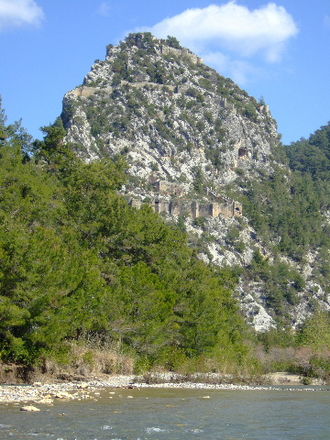
The Alara Castle, is a historic fortification located at Alanya district of Antalya Province in southern Turkey.

Alara Han
Alara Han is a 13th-century Seljuk caravanserai on the Alara river, about 40 km west of Alanya, built under Sultan Alaeddin Keykubad on the trade route between Konya and Alanya.

Aperlae
Aperlae or Aperlai was an ancient city on the southern coast of ancient Lycia. It did not play any significant role in history or politics, yet its lifespan of 1,300 years is worth note.

Apollonia
Apollonia was a city in ancient Lycia. Its ruins are located near Kiliçli (Sıçak), a small village in the Kaş district of Antalya Province, Turkey.

Arapsu Bridge
The Arapsu Bridge is a Roman bridge in Antalya, Turkey. The well-preserved footbridge lies in the Arapsuyu district, 5–6 km west to the city center, at the foot of an ancient mound which is associated with the Greek colony of Olbia.

Ariassus
Ariassus or Ariassos was a town in Pisidia, Asia Minor built on a steep hillside about 50 kilometres inland from Attaleia (modern Antalya).

Arycanda
Arycanda or Arykanda is an Ancient Lycian city, former bishopric and present Catholic titular see in Antalya Province in the Mediterranean Region of Turkey.

Aspendos
Aspendos or Aspendus was an ancient Greco-Roman city in Antalya province of Turkey. The site is located 40 km east of the modern city of Antalya.

Colybrassus
Colybrassus or Kolybrassos was a city in Cilicia Tracheia (modern-day Turkey) that belonged to the Roman province of Pamphylia Prima, identified as such by Ptolemy.

Phaselis
Phaselis or Faselis was a Greek and Roman city on the coast of ancient Lycia. Its ruins are located north of the modern town Tekirova in the Kemer district of Antalya Province in Turkey.

Harpy Tomb
The Harpy Tomb is a marble chamber from a pillar tomb that stands in the abandoned city of Xanthos, capital of ancient Lycia, a region of southwestern Anatolia in what is now Turkey.

Idebessos
Idebessos or Idebessus, also known as Edebessus or Edebessos or, was an ancient city in Lycia. It was located at the foot of the Bey Mountains to the west of the Alakır river valley.

Aytap
Aytap is a historical port city that is 30 km-33 km, east of Alanya, located in the Mediterranean Region, Turkey. Along with Alanya, Aytap is situated in the district of the Antalya Province.

Kaleiçi
Kaleiçi is the historic city center of Antalya, located along the Mediterranean coast in southern Turkey. Enclosed by ancient city walls and overlooking the old harbor, it represents the original core of the city.

Bridge near Limyra
The Bridge near Limyra is a late Roman bridge in Lycia, in modern south-west Turkey, and one of the oldest segmented arch bridges in the world.

Cyaneae
Cyaneae, also spelled Kyaneai or Cyanae, was a town of ancient Lycia, or perhaps three towns known collectively by the name.
Limyra
Limyra was a small city in ancient Lycia on the southern coast of Asia Minor, on the Limyrus River.

Nisa
Nisa, also Nyssa or Nysa or Neisa, was a town in ancient Lycia near the source of the River Xanthus.

Olympos
Olympus or Olympos is an ancient city in Lycia. Although Olympus comprised an extensive territorium as identified by tomb inscriptions, it had a medium-sized city center.

Oluk Bridge (Eurymedon)
The Eurymedon Bridge is a Roman bridge over the river Eurymedon (modern Köprüçay River) near Selge in Pisidia in southern Turkey. It is part of the road winding up from the coastal region Pamphylia to the Pisidian hinterland.

Rhodiopolis
Rhodiapolis, also known as Rhodia and Rhodiopolis, was a city in ancient Lycia. Today it is located on a hill northwest of the modern town Kumluca in Antalya Province, Turkey.

Seleucia
Seleucia was originally an ancient Greek city on the Mediterranean coast of Pamphylia, in Anatolia, approximately 15 km northeast of Side; the site is about 1 km north of the village of Bucakşeyhler (also Bucakşıhler), approximately 12 km northeast of Manavgat, Antalya…

Selge
Selge was an important city in ancient Pisidia and later in Pamphylia, on the southern slope of Mount Taurus, modern Antalya Province, Turkey, at the part where the river Eurymedon River forces its way through the mountains towards the south.

Selinus
Selinus or Selinous was a port-town on the west coast of Rough Cilicia and later of Isauria, at the mouth of a small river of the same name, now called Musa Çay. It is located west of the modern city of Gazipaşa in Turkey.

Sillyon
Sillyon, in Byzantine times called Syllaeum or Syllaion, was an important fortress and city near Attaleia in Pamphylia, on the southern coast of modern Turkey.

Syedra
Syedra was an ancient port city in region of ancient Cilicia, Pamphylia, or Isauria, on the southern coast of modern-day Turkey between the towns of Alanya and Gazipaşa.

Teimiussa
Teimiussa, also spelt Teimioussa or Timiussa, also known as Tristomon, was a port town of ancient Lycia, near the ancient settlement Tyberissus. The name is not attested in history, but is derived from epigraphic and other evidence.

Termessus
Termessos, also known as Termessos Major, was a Pisidian city built at an altitude of about 1000 metres at the south-west side of Solymos Mountain (modern Güllük Dağı) in the Taurus Mountains (modern Korkuteli, Antalya Province, Turkey).

Trebenna
Trebenna or Trabenna was a city in ancient Lycia, at the border with Pamphylia, and at times ascribed to that latter region. Its ruins are located east of the modern town Çağlarca in the Konyaaltı district of Antalya Province, Turkey.
Museums
Kaleici Museum
The Kaleiçi Museum is housed in a restored Ottoman mansion and the former Greek Orthodox Church of St George in Antalya's old town. It displays Turkish tiles, ceramics and a reconstruction of traditional Antalya home life.

Atatürk's House Museum
Atatürk's House Museum is a national museum in Antalya, Turkey dedicated to the visits of Mustafa Kemal Atatürk to this city.

Alanya Archaeological Museum
Alanya Archaeological Museum is an archaeological museum in Alanya, Turkey. The museum is divided into two sections, with displays of archaeological and ethnographic artifacts.

Antalya Museum
The Antalya Museum or Antalya Archaeological Museum was one of Turkey's largest museums, located in Muratpaşa, Antalya. It includes 13 exhibition halls and an open-air gallery.

Kızıl Kule
The Red Tower is a historical tower in the Turkish city of Alanya. The building is considered to be the symbol of the city, and is used on the city's flag.
Places of worship

Antalya Mosque
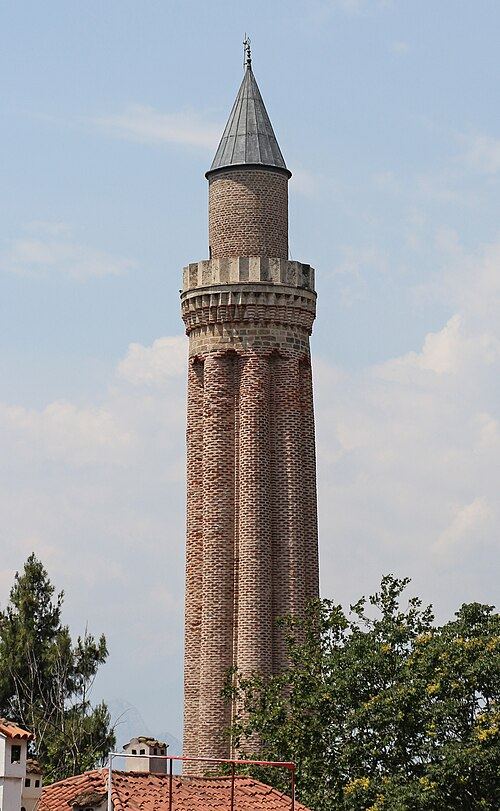
Yivli Minaret Mosque is a historic mosque located in Kaleiçi, the old town center of Antalya, Turkey. Situated along Cumhuriyet Street near Kalekapısı Square, it is one of the city’s most important landmarks.

Tekeli Mehmet Paşa Mosque
The Tekeli Mehmet Paşa Mosque is a mosque in the city of Antalya, Turkey. The mosque takes its name from Lala Mehmed Pasa.

Kesik Minare
The Kesik Minare Cami (Broken Minaret Mosque), Korkut Cami or Cumanın Cami standing in the streets of Kaleiçi (Old Antalya) in southern Turkey, was originally built as a Roman temple in the 2nd century AD.
St. Nicholas Church, Demre
St. Nicholas Church is an ancient East Roman basilica church in the ancient city of Myra which had been in use until the local Greeks had to leave in 1922, and is now a museum located in modern Demre, Antalya Province, Turkey.

Kuyularonu Mosque
The Kuyularonu Mosque is a mosque in Turkey situated in the city of Alanya in the province of Antalya Province.

Murat Paşa Mosque
The Murat Paşa Mosque is an Ottoman mosque in the Muratpaşa borough of Antalya, Turkey.
Monuments
Hadrian's Gate
Hadrian's Gate is a memorial gate located in Antalya, Turkey, which was built in the name of the Roman emperor Hadrian, who visited the city in 130 CE.

Stadiasmus Patarensis
The Stadiasmus Patarensis, also known as the Stadiasmus Provinciae Lyciae and the Miliarium Lyciae, is an ancient Roman milliarium from the city of Patara. The stadiasmus, shaped as a pillar, served as a monumental public itinerarium.
Nature

Karaalioğlu Park
Karaalioğlu Park is a large park in Antalya, Turkey. It is just south of Kaleiçi in the city center, easily reached on foot or by tram.

Manavgat Waterfall
Manavgat Waterfall on the Manavgat River is near the city of Side, 3 km (2 mi) north of Manavgat, Turkey. Its high flow over a wide area as it falls from a low height is best viewed from a high altitude.
Kaputaş Beach
Kaputaş Beach is a small beach between Kaş and Kalkan in southwestern Turkey.

Olympos Beydaglari National Park
Beydağları Coastal National Park, a.k.a. Olympos Beydagları National Park, is a national park in Antalya Province, southern Turkey. The national park was established on March 16, 1972, by government decree.

Damlataş Cave
Damlataş Cave is a cave in Alanya district of Antalya Province, in southern Turkey.

Düden Waterfalls
The Düden Waterfalls are two waterfalls of the Düden River in the province of Antalya, Turkey.

Altınbeşik Düdensuyu Cave
Düdensuyu Cave, also called Altınbeşik Cave, is in the İbradı district of Antalya. Discovered in 1966, it is known for its underground lake and terraced travertine pools and is explored by boat.

Cape Gelidonya
Cape Gelidonya, formerly Kilidonia or Killidonia is a cape or headland on the Teke Peninsula in the chain of Taurus Mountains, located on the southern coast of Anatolia between the Gulf of Antalya and the Bay of Finike.

Karain Cave
Karain Cave is a Paleolithic archaeological site located at Yağca Village 27 km (17 mi) northwest of Antalya city in the Mediterranean region of Turkey.

Kleopatra beach
Cleopatra Beach is Alanya's best-known sandy beach, stretching west of the castle peninsula next to Damlataş Cave.

Konyaaltı Beach
Konyaaltı Beach is one of the two main beaches of Antalya, the other being Lara Beach. The beach is located on the western side of the city and stretches for 13 km primarily composed of fine pebbles, but also has some sand.

Köprülü Canyon
Köprülü Canyon is a canyon and a National Park in the Province of Antalya, Turkey.

Kurşunlu Waterfall
Kurşunlu Waterfall is a waterfall set in a shaded nature park about 20 km east of Antalya city centre, with walking paths, pools and picnic areas.

Öküzini-cave
Öküzini Cave, also known as "oxen cave," is located in southwestern Turkey around 32 km northwest of modern Antalya.

Zeytintaşı Cave
Zeytintaşı Cave is a show cave in Antalya Province, southwestern Turkey. It is a registered natural monument of the country. The cave is located at Akbaş village in Serik district of Antalya Province.
Explore Antalya with your camera
Hear the stories on the spot, complete routes, collect badges. Sightlore is coming soon to the App Store.