Romania
Things to do in Bucharest
53 places15 stories1 routes
Sightlore has 53 places to explore in Bucharest, and 15 of them come with a 60-second story in 5 languages. Point your camera at a landmark to learn its name and story, and earn points and badges at the places you actually visit.
Bucharest's must-sees
The city's most important places. In the app you see how many you've visited and earn a badge when you've seen them all.
- 1

Palace of the Parliament
The Palace of the Parliament, initially designed during Communist times as the People's House (Casa Poporului) or (less frequently used) the House of the Republic (Casa Republicii), is the seat of the Parliament of Romania, located atop Dealul Spirii in Bucharest, the…
Read its story → - 2

Curtea Veche
Curtea Veche (the Old Princely Court) was built as a palace or residence during the rule of Vlad III Dracula in 1459. Archaeological excavations started in 1953, and now the site is operated by the Muzeul Municipiului București in the historic centre of Bucharest, Romania.
- 3

National Military Club
The Palace of the National Military Circle, also known as the Officers' Circle Palace is located on Constantin Mile street in Bucharest, Romania.
- 4
Revolution Square, Bucharest
Revolution Square is a square in central Bucharest, on Calea Victoriei.
- 5

National Cathedral
The National Cathedral, also known as the People's Salvation Cathedral, is an Eastern Orthodox cathedral in Bucharest, Romania, built to serve as the patriarchal cathedral of the Romanian Orthodox Church.
- 6

Romanian Patriarchal Cathedral
The Romanian Orthodox Patriarchal Cathedral (also known as the Metropolitan Church) is a functioning religious and civic landmark, on Dealul Mitropoliei, in Bucharest, Romania.
- 7

National Museum of Romanian History
The National History Museum of Romania is a museum located at 12 Calea Victoriei in Bucharest, Romania, which contains Romanian historical artifacts from prehistoric times up to modern times.
- 8

Manuc's Inn
Manuc's Inn is the oldest operating hotel building in Bucharest, Romania. It also houses a popular restaurant, several bars, a coffee-house, and (facing the street) several stores and an extensive bar.
- 9

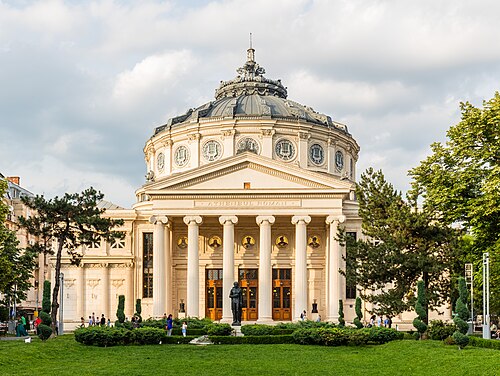
Romanian Athenaeum
The Romanian Athenaeum is a concert hall in the center of Bucharest, Romania, and a landmark of the Romanian capital city.
- 10

Curtea Veche Church
The Curtea Veche Church is a Romanian Orthodox church located at 33 Franceză Street in the Lipscani quarter of Bucharest, Romania. It is dedicated to the Feast of the Annunciation and to Saint Anthony the Great.
Discovery routes in Bucharest
Visit the stops in any order and tap "Check in" at each one; finish the route to earn points and its own badge.
Bucharest: from Calea Victoriei to the Palace of Parliament
From Revolution Square, the Romanian Athenaeum and the National Museum of Art to the Kretzulescu Church, the Military Circle and the CEC Palace; past the National History Museum, Stavropoleos, Lipscani, the Old Princely Court and Manuc's Inn to the Patriarchal Cathedral, the Palace of Parliament and the National Cathedral.
Places to visit
Historic sites
Romanian Athenaeum
The Romanian Athenaeum is a concert hall in the center of Bucharest, Romania, and a landmark of the Romanian capital city.
National Military Club
The Palace of the National Military Circle, also known as the Officers' Circle Palace is located on Constantin Mile street in Bucharest, Romania.

CEC Palace
The CEC Palace in Bucharest, Romania, built between 8 June 1897 and 1900, and situated on Calea Victoriei opposite the National Museum of Romanian History, is the headquarters of CEC Bank.

Lipscani
Lipscani is a street and a district of Bucharest, Romania, which from the Middle Ages to the early 19th century was the most important commercial area of the city and Wallachia.
Curtea Veche
Curtea Veche (the Old Princely Court) was built as a palace or residence during the rule of Vlad III Dracula in 1459. Archaeological excavations started in 1953, and now the site is operated by the Muzeul Municipiului București in the historic centre of Bucharest, Romania.
Manuc's Inn
Manuc's Inn is the oldest operating hotel building in Bucharest, Romania. It also houses a popular restaurant, several bars, a coffee-house, and (facing the street) several stores and an extensive bar.
Palace of the Parliament
The Palace of the Parliament, initially designed during Communist times as the People's House (Casa Poporului) or (less frequently used) the House of the Republic (Casa Republicii), is the seat of the Parliament of Romania, located atop Dealul Spirii in Bucharest, the…

Bellu Cemetery
Șerban Vodă Cemetery (commonly known as Bellu Cemetery) is the largest and most famous cemetery in Bucharest, Romania.

Cotroceni Palace
Cotroceni Palace is the official residence of the President of Romania. It is located at Bulevardul Geniului, nr. 1, in Bucharest, Romania. The palace also houses the National Cotroceni Museum.

State Jewish Theater
Teatrul Evreiesc de Stat (TES, the State Jewish Theater) in Bucharest, Romania is a theater specializing in Jewish-related plays. It is the oldest Yiddish-language theater with uninterrupted activity in the world.

Ghencea Cemetery
Ghencea Cemetery is located in Ghencea neighbourhood of Bucharest, on Ghencea Boulevard, in Sector 6. The cemetery has two sections, civilian and military.

Mogoșoaia Palace
Mogoșoaia Palace is situated about 10 kilometres (6.2 mi) from Bucharest, Romania. It was built between 1698 and 1702 by Constantin Brâncoveanu in what is called the Romanian Renaissance style or Brâncovenesc style.

Odeon Theatre
The Odeon Theatre (Teatrul Odeon in Romanian) is a theatre in Bucharest, Romania, located on Calea Victoriei, and is one of the best-known performing arts venues in Bucharest.
Museums
National Museum of Art of Romania
The National Museum of Art of Romania is located in the Royal Palace in Revolution Square, central Bucharest.
National Museum of Romanian History
The National History Museum of Romania is a museum located at 12 Calea Victoriei in Bucharest, Romania, which contains Romanian historical artifacts from prehistoric times up to modern times.

Jewish Museum in Bucharest
The Jewish Museum in Bucharest, Romania is located in the former Templul Unirea Sfântă (United Holy Temple) synagogue, which survived World War II. The name has several variants, including Museum of the History of the Romanian Jewish Community.

Dimitrie Gusti National Village Museum in Bucharest
The Village Museum or formally National Museum of the Village "Dimitrie Gusti" is an open-air ethnographic museum located in the King Michael I Park, Bucharest, Romania. The museum showcases traditional Romanian village life.

Dimitrie Leonida Technical Museum
The Dimitrie Leonida Technical Museum was founded in 1909 by Dimitrie Leonida, inspired by the München Technical Museum, he had visited during his studies in Charlottenburg Polytechnic Institute.

“Grigore Antipa” National Museum of Natural History
The Grigore Antipa National Museum of Natural History is a natural history museum, located in Bucharest, Romania.

National Military Museum
The King Ferdinand I National Military Museum, located at 125-127 Mircea Vulcănescu St., Bucharest, Romania, was established on 18 December 1923 by King Ferdinand I. It has been at its present site since 1988, in a building finished in 1998.

Primăveri Palace
Primăverii Palace, also known as Casa Ceaușescu, is a building in Bucharest, Romania, located in the Primăverii district of the city. Since 2016 it has housed a museum.

Romanian Peasant Museum
The National Museum of the Romanian Peasant is a museum in Bucharest, Romania, with a collection of textiles (especially costumes), icons, ceramics, and other artifacts of Romanian peasant life.

National Museum of Contemporary Art
The National Museum of Contemporary Art is a contemporary art museum in Bucharest, Romania. The museum is located in a new glass wing of the Palace of the Parliament, one of the largest administrative buildings in the world.

Foișorul de Foc
Foișorul de Foc (literally The Fire Tower) is a 42 metres (138 feet) high building in Bucharest, Romania, between Obor, Calea Moșilor, and Nerva-Traian. It was used in the past as an observation tower by the firemen.

Zambaccian Museum
The Zambaccian Museum in Bucharest, Romania is a museum in the former home of Krikor Zambaccian, a businessman and art collector.
Places of worship

Kretzulescu Church
Kretzulescu Church is an Eastern Orthodox church in central Bucharest, Romania. Built in the Brâncovenesc style, it is located on Calea Victoriei, nr. 45A, at one of the corners of Revolution Square, next to the former Royal Palace.

Stavropoleos Monastery
Stavropoleos Monastery, also known as Stavropoleos Church during the last century when the monastery was dissolved, is an Eastern Orthodox monastery for nuns in central Bucharest, Romania. Its church is built in Brâncovenesc style.
Curtea Veche Church
The Curtea Veche Church is a Romanian Orthodox church located at 33 Franceză Street in the Lipscani quarter of Bucharest, Romania. It is dedicated to the Feast of the Annunciation and to Saint Anthony the Great.
Romanian Patriarchal Cathedral
The Romanian Orthodox Patriarchal Cathedral (also known as the Metropolitan Church) is a functioning religious and civic landmark, on Dealul Mitropoliei, in Bucharest, Romania.
National Cathedral
The National Cathedral, also known as the People's Salvation Cathedral, is an Eastern Orthodox cathedral in Bucharest, Romania, built to serve as the patriarchal cathedral of the Romanian Orthodox Church.

Antim Monastery
The Antim Monastery is a Romanian Orthodox church located in Bucharest, Romania on Mitropolit Antim Ivireanu Street, no. 29. It was built between 1713 and 1715 by Saint Anthim the Iberian, at that time a Metropolitan Bishop of Wallachia.

Cathedral of St Joseph
Saint Joseph Cathedral is a Catholic church in Bucharest, Romania, that serves as the cathedral of the Roman Catholic Archdiocese of Bucharest. It is located at 19 General Berthelot Street.

Bucharest Bărăția Church
Bărăția is one of the Roman Catholic churches in Bucharest, Romania.

Cathedral Saint Basil the Great
Saint Basil the Great Cathedral is a Romanian Greek-Catholic church in Bucharest that serves as the cathedral of the Romanian Catholic Eparchy of Bucharest. It is located at 50 Polonă Street.

Chiajna Monastery
Chiajna Monastery is a ruined church situated on the outskirts of Bucharest, Romania which is the subject of many legends, including the story that it is cursed.

Armenian Cathedral, Bucharest
The Armenian Church is an Armenian Apostolic church located at 43 Carol I Boulevard in Bucharest, Romania. It is dedicated to the Archangels Michael and Gabriel.

Italian Church
The Italian Church of the Most Holy Redeemer is a Roman Catholic church located in Bucharest, Romania, at 28 Nicolae Bălcescu Boulevard.

Mihai Vodă Monastery
The Mihai Vodă Monastery, founded by Mihai Viteazul, is one of the oldest buildings in Bucharest. It was built in 1591, surrounded by stone walls, similar to a fortress.

Radu Vodă Monastery
Radu Vodă Monastery is a Romanian Orthodox monastery in Bucharest, Romania.

Saint Nicholas Church - Ghica
St. Nicholas Russian Church is located in central Bucharest, Romania, just off University Square.

Snagov Monastery
The Snagov Monastery, also known as the Vlad Țepeș Monastery is a medieval monastery and important historical monument located in southern Romania in the county of Ilfov, on an island in the northern reaches of Lake Snagov, belonging to the commune of Snagov, and in…

St. Elefterie Church
New St. Eleftherios Church is a church near the Opera House in Bucharest, Romania. It is located at 1 Saint Elefterie Street and was designed by the architect Constantin Iotzu.

Saint Spyridon the New Church
The Saint Spyridon the New Church is a Romanian Orthodox church in Bucharest, Romania on Calea Șerban Vodă, no.
Monuments
Revolution Square, Bucharest
Revolution Square is a square in central Bucharest, on Calea Victoriei.

Tomb of the Unknown Soldier
The Tomb of the Unknown Soldier is a monument located in Bucharest, Romania. Dedicated to the soldiers who died while fighting for Romania, it is one of many such national tombs across the world.

Arcul de Triumf Bucharest
Arcul de Triumf is a triumphal arch located on the Kiseleff Road, in the northern part of Bucharest, Romania.
Nature

Bucharest Botanical Garden
The Bucharest Botanical Garden, now named after its founder, Dimitrie Brândză, is located in the Cotroceni neighbourhood of Bucharest, Romania.

Zoo Băneasa
Zoo Băneasa is a zoo in Bucharest, Romania, located in the northern district of the city called Băneasa. The park was founded in 1955 as a service of the Municipal Household Section of the People's Council of the Capital.

Carol Park
Carol I Park is a public park in Bucharest, Romania, named after King Carol I of Romania.

Cișmigiu Gardens
The Cișmigiu Gardens or Cișmigiu Park are a public park in the center of Bucharest, Romania, spanning areas on all sides of an artificial lake. The gardens' creation was an important moment in the history of Bucharest.

Herăstrău Park
King Michael I Park, formerly Herăstrău Park, is a large park on the northern side of Bucharest, Romania, around Lake Herăstrău, one of the lakes formed by the Colentina River.

Tineretului Park
Tineretului Park is a large public park in southern Bucharest (Sector 4).

Văcărești Nature Park
Văcărești Nature Park is a nature park located in Sector 4 of Bucharest, Romania, containing the wetlands surrounding Lake Văcărești.
Explore Bucharest with your camera
Hear the stories on the spot, complete routes, collect badges. Sightlore is coming soon to the App Store.