Croatia
Things to do in Dubrovnik
45 places23 stories3 routes
Sightlore has 45 places to explore in Dubrovnik, and 23 of them come with a 60-second story in 5 languages. Point your camera at a landmark to learn its name and story, and earn points and badges at the places you actually visit.
Dubrovnik's must-sees
The city's most important places. In the app you see how many you've visited and earn a badge when you've seen them all.
- 1

Stradun
Stradun or Placa (Stradone or Corso), whose name derives from Venetian, and means "large road" or "wide road", is the main street of Dubrovnik, Croatia.
- 2

Lovrijenac
Fort Lovrijenac or St. Lawrence Fortress, Italian Fortezza di San Lorenzo, often called "Dubrovnik's Gibraltar", is a fortress and theater outside the western wall of the city of Dubrovnik in Croatia, 37 metres (121 ft) above sea level.
- 3

Rector's Palace, Dubrovnik
The Rector's Palace is a palace in the city of Dubrovnik that used to serve as the seat of the Rector of the Republic of Ragusa between the 14th century and 1808. It was also the seat of the Minor Council and the state administration.
- 4

Walls of Ston
The Walls of Ston are a series of defensive stone walls, originally more than 7 kilometres (4.3 mi) long, that surrounded and protected the city of Ston, in Dalmatia, part of the Republic of Ragusa, in what is now southern Croatia.
- 5

Trsteno Arboretum
Trsteno Arboretum is a Mediterranean arboretum located in Trsteno, southern Croatia.
- 6

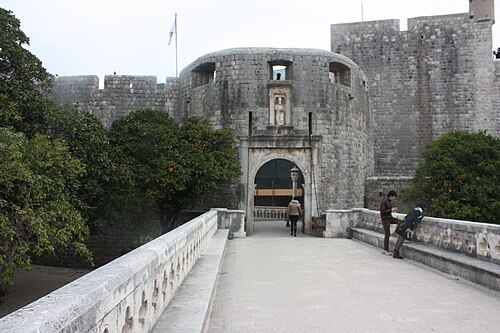
Pile Gate, Dubrovnik
The western entrance to the old town, built in 1460 on the site of an earlier gate.
- 7

Ploče Gate, Dubrovnik
The eastern entrance to the old town, with outer and inner gates and a stone and wooden bridge.
- 8

Fort Imperial
The main fort on top of Srđ, built to guard the northern approaches to the city.
- 9

Minčeta
Round tower at the north of the walls, the high point of the landward defences and a symbol of the city.
- 10

Dubrovnik Cathedral
The Dubrovnik Cathedral is a Roman Catholic cathedral in Dubrovnik, Croatia. It is the seat of the Diocese of Dubrovnik.
Discovery routes in Dubrovnik
Visit the stops in any order and tap "Check in" at each one; finish the route to earn points and its own badge.
Dubrovnik: Old Town and Stradun
From the Pile Gate to the Ploče Gate: Onofrio's Fountain, the Franciscan monastery, Stradun, St Blaise, the Rector's Palace, the cathedral, the Jesuit church and the Dominican monastery.
Dubrovnik: Walls and Fortresses
Start at Lovrijenac and climb onto the walls that ring the city: Bokar, Minčeta, Revelin, St John's Fortress and the Maritime Museum.
Dubrovnik: Srđ, Lokrum, Trsteno and Ston
Srđ and Fort Imperial above the city, Lokrum island across the water, the Renaissance garden of Trsteno and the walls of Ston, among Europe's longest.
Places to visit
Historic sites
Pile Gate, Dubrovnik
The western entrance to the old town, built in 1460 on the site of an earlier gate.
Stradun
Stradun or Placa (Stradone or Corso), whose name derives from Venetian, and means "large road" or "wide road", is the main street of Dubrovnik, Croatia.
Ploče Gate, Dubrovnik
The eastern entrance to the old town, with outer and inner gates and a stone and wooden bridge.
Lovrijenac
Fort Lovrijenac or St. Lawrence Fortress, Italian Fortezza di San Lorenzo, often called "Dubrovnik's Gibraltar", is a fortress and theater outside the western wall of the city of Dubrovnik in Croatia, 37 metres (121 ft) above sea level.

Bokar Fortress
One of the main towers of the walls, at their western end next to Lovrijenac.

Walls of Dubrovnik
The Walls of Dubrovnik are a series of defensive stone walls surrounding the city of Dubrovnik in southern Croatia.
Minčeta
Round tower at the north of the walls, the high point of the landward defences and a symbol of the city.

Fort Revelin
Fortress northeast of the walls, cut off by a deep moat and linked by a bridge, built against the Ottomans.

Saint John's Fortress
Fortress built in 1346 to guard the old harbour, now home to the Maritime Museum.
Fort Imperial
The main fort on top of Srđ, built to guard the northern approaches to the city.
Walls of Ston
The Walls of Ston are a series of defensive stone walls, originally more than 7 kilometres (4.3 mi) long, that surrounded and protected the city of Ston, in Dalmatia, part of the Republic of Ragusa, in what is now southern Croatia.

Boninovo Cemetery
Dubrovnik's main cemetery, about 1 km northwest of Pile.

Daksa Lighthouse
Lighthouse on the north side of Daksa islet, at the approach to Gruž harbour.

Franjo Tuđman Bridge
The Franjo Tuđman Bridge is a cable-stayed bridge carrying the D8 state road at the western approach to Dubrovnik, Croatia across Rijeka Dubrovačka near Port of Gruž.

Grebeni Lighthouse
Lighthouse on the largest of the Grebeni rocks, west of Dubrovnik harbour.

Port of Gruž
Dubrovnik's international passenger port.
Museums
Rector's Palace, Dubrovnik
The Rector's Palace is a palace in the city of Dubrovnik that used to serve as the seat of the Rector of the Republic of Ragusa between the 14th century and 1808. It was also the seat of the Minor Council and the state administration.

Maritime Museum
Museum in St John's Fortress telling the seafaring history of the Republic of Dubrovnik.
Places of worship

St. Saviour Church
St. Saviour Church is a small votive church located on Stradun in Dubrovnik's Old Town. It is dedicated to Jesus Christ.

Franciscan Church and Monastery
The Franciscan friary and church is a large complex belonging to the Order of the Friars Minor. It consists of a friary, a church, a library, and a pharmacy. It is situated in Stradun, the main street of Dubrovnik, Croatia.

St Blaise's Church
The Church of St. Blaise is a Catholic Baroque church in Dubrovnik and one of the city's major sights.
Dubrovnik Cathedral
The Dubrovnik Cathedral is a Roman Catholic cathedral in Dubrovnik, Croatia. It is the seat of the Diocese of Dubrovnik.

Saint Ignatius Church
The Collegium Ragusinum, sometimes also Rhagusinum, was the Jesuit college in the Republic of Ragusa, now the city of Dubrovnik in Croatia.

Dominican Church and Monastery in Dubrovnik
Dominican friary founded in 1225 in the east of the old town, built against the walls.

St. Claire's convent
The best-known of Dubrovnik's eight convents, just south of the Pile Gate.

Church of St Mary at Danče
Votive church in a convent complex with a cemetery and remains of one of the world's first quarantines, from the 15th century.

Holy Annunciation Orthodox church
The Church of the Holy Annunciation is a Serbian Orthodox church in Dubrovnik, Croatia.
Monuments

Onofrio fountain
Polygonal fountain with 16 carved masks, built in 1438 by Onofrio della Cava of Naples.

Little Onofrio Fountain
Small fountain at the eastern end of Stradun that supplied water to the Luža market.

Cross on Srđ
Stone cross raised on Srđ in 1935 by Bishop Josip Marija Carević for the 1900th anniversary of the Crucifixion.
Nature

Srđ
Srđ is a low mountain just behind the walled city of Dubrovnik in Dalmatia, Croatia. The mountain, part of the Dinaric Alps, has a height of 412 metres (1,352 ft).

Lokrum
Lokrum is an island in the Adriatic Sea 600 metres (1,969 feet) from the city of Dubrovnik, Croatia. It stretches from northwest to southeast and receives regular ferry service from the Old City port.
Trsteno Arboretum
Trsteno Arboretum is a Mediterranean arboretum located in Trsteno, southern Croatia.

St. Jakov Beach
Beach in a quiet cove below the church of St James, about 1 km from the old town.

Banje Beach
Dubrovnik's best-known pebble beach, just east of the old town, facing the walls and Lokrum.

Bellevue Beach
Dubrovnik beach in a pretty bay below the hotel of the same name.

Buža Beach
Rocky beach below the southern walls, reached through a small opening (buža) in the wall.

Cava Beach
Naturist beach on the Lapad peninsula, between Copacabana and President beaches.

Copacabana Beach
Popular pebble beach at Babin Kuk; facing the mouth of the Ombla, its water stays a little cooler.

Gradac, Dubrovnik
Park in Dubrovnik opened on 23 July 1898, looking towards Lovrijenac.

Lokrum Beaches
Mostly rocky beaches along the shores of Lokrum island opposite Dubrovnik.

Petka
Protected forest park on two hills above the Lapad peninsula.

Porporela
Breakwater in the old harbour, a much-loved swimming spot celebrated in songs.

President Beach
Pebble beach below the hotel of the same name at Babin Kuk.

Tri brata Beach
Beach below the rock of the same name, called after a tragedy that happened there.
Explore Dubrovnik with your camera
Hear the stories on the spot, complete routes, collect badges. Sightlore is coming soon to the App Store.