Spain
Things to do in Seville
30 places30 stories2 routes
Sightlore has 30 places to explore in Seville, and 30 of them come with a 60-second story in 5 languages. Point your camera at a landmark to learn its name and story, and earn points and badges at the places you actually visit.
Seville's must-sees
The city's most important places. In the app you see how many you've visited and earn a badge when you've seen them all.
- 1

Giralda
The Giralda is the bell tower of Seville Cathedral in Seville, Spain.
- 2

Seville Cathedral
The Cathedral of Saint Mary of the See, better known as Seville Cathedral (Catedral de Sevilla), is a Catholic cathedral in Seville, Andalusia, Spain.
Read its story → - 3

Torre del Oro
The Torre del Oro is a dodecagonal military watchtower in Seville, southern Spain. It was erected by the Almohad Caliphate in order to control access to Seville via the Guadalquivir river.
- 4

Parque de María Luisa
The Parque de María Luisa (María Luisa Park) is a public park that stretches along the Guadalquivir River in Seville, Spain. It is Seville's principal green area.
- 5

General Archive of the Indies
The Archivo General de Indias, often simply called the Archive of the Indies, was created by Charles III and inaugurated in 1785. It is housed in the former merchant guild building in Seville, Spain, built in the late 16th century.
- 6

Plaza de España
The Plaza de España ("Spain Square", in English) is a plaza in Maria Luisa Park in Seville, Spain.
- 7

Isabel II Bridge
The Puente de Isabel II, Puente de Triana or Triana Bridge, is a metal arch bridge in Seville, Spain, that connects the Triana neighbourhood with the centre of the city.
- 8

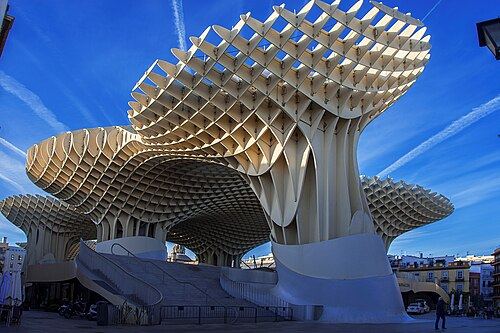
Metropol Parasol
The Setas de Sevilla ("Mushrooms of Seville") or Las Setas ("The Mushrooms"), initially titled Metropol Parasol, is a large, predominantly wood structure located at La Encarnación square in the old quarter of Seville, Spain.
- 9

Santa Cruz
Santa Cruz, is the primary tourist neighborhood of Seville, Spain, and the former Jewish quarter of the medieval city.
- 10

Palacio de San Telmo
The Palace of San Telmo is a historic edifice in Seville, southern Spain, formerly the Universidad de Mareantes (a university for navigators), now the seat of the presidency of the Andalusian Autonomous Government.
Discovery routes in Seville
Visit the stops in any order and tap "Check in" at each one; finish the route to earn points and its own badge.
Heart of Seville
From the Setas viewing deck to the Church of the Saviour, the cathedral and the Giralda, the Royal Alcázar, the Archive of the Indies and the narrow lanes of Santa Cruz.
Guadalquivir and María Luisa
From the Triana Bridge along the river to the Maestranza bullring and the Golden Tower, then past San Telmo Palace to María Luisa Park and the Plaza de España.
Places to visit
Historic sites

Reales Alcázares
The Alcázar of Seville, officially called Royal Alcázar of Seville, is a historic royal palace in Seville, Spain and one of the official residences of the Spanish royal family.
Santa Cruz
Santa Cruz, is the primary tourist neighborhood of Seville, Spain, and the former Jewish quarter of the medieval city.
Isabel II Bridge
The Puente de Isabel II, Puente de Triana or Triana Bridge, is a metal arch bridge in Seville, Spain, that connects the Triana neighbourhood with the centre of the city.

Plaza de toros de la Maestranza
The Plaza de Toros de la Real Maestranza de Caballería de Sevilla is a 12,000-capacity bullring in Seville, Spain. During the annual Seville Fair in Seville, it is the site of one of the most well-known bullfighting festivals in the world.
Torre del Oro
The Torre del Oro is a dodecagonal military watchtower in Seville, southern Spain. It was erected by the Almohad Caliphate in order to control access to Seville via the Guadalquivir river.

Puente del Alamillo
The Alamillo Bridge is a structure in Seville, Andalucia (Spain), which spans the Canal de Alfonso XIII, allowing access to La Cartuja, a peninsula located between the canal and the Guadalquivir River.

Casa de Pilatos
La Casa de Pilatos (Pilate's House) is an Andalusian palace in Seville, Spain, which serves as the permanent residence of the Dukes of Medinaceli. It is an example of an Italian Renaissance building with Mudéjar elements and decorations.

Torre de la Plata
The Torre de la Plata is an octagonal military tower in Andalusia, located in present-day Seville, southern Spain. It was constructed by the Almohad Caliphate.

Lope de Vega Theatre
The Lope de Vega Theatre is a Baroque Revival theatre that was built for the Ibero-American Exposition of 1929 in Seville, Spain, in the same building as the Exhibition Casino.

Puerta de la Macarena
The Puerta de la Macarena, also known as Arco de la Macarena, is one of the only three city gates that remain today of the original walls of Seville, alongside the Postigo del Aceite and the Puerta de Córdoba.

Teatro de la Maestranza
The Teatro de la Maestranza is an opera house located in Seville, Spain.
Museums
General Archive of the Indies
The Archivo General de Indias, often simply called the Archive of the Indies, was created by Charles III and inaugurated in 1785. It is housed in the former merchant guild building in Seville, Spain, built in the late 16th century.

Archeological Museum of Seville
The Archeological Museum of Seville is a museum in Seville, southern Spain, housed in the Pabellón del Renacimiento, one of the pavilions designed by the architect Aníbal González.

Museo de Bellas Artes de Sevilla
The Museum of Fine Arts of Seville is one of the main art galleries in Seville, Spain, with a collection of Spanish visual arts from the medieval period to the early 20th century.
Places of worship

Iglesia del Divino Salvador
The Church of San Salvador is a church in Seville, Spain. It is the second-largest church in Seville, after the city's cathedral.
Seville Cathedral
The Cathedral of Saint Mary of the See, better known as Seville Cathedral (Catedral de Sevilla), is a Catholic cathedral in Seville, Andalusia, Spain.

Hospital de los Venerables
The Hospital de los Venerables (officially the Hospital de Venerables Sacerdotes, Hospital of Venerable Priests, popularly known as the Hospital of the Venerable) of Seville, Spain, is a baroque 17th-century building which served as a residence for priests.

Monastery of the Cartuja
The Monastery of Santa María de las Cuevas, also known as the Monastery of the Cartuja (Charterhouse), is a religious building on the Isla de La Cartuja in Seville, southern Spain.

Basilica of the Macarena
The Basilica of the Macarena houses the Esperanza Macarena, one of Seville's most revered images of the Virgin Mary. The most famous Holy Week procession sets out from here.

Iglesia de San Luis de los Franceses
The Church of Saint Louis of France, located in the historic district of Seville, Spain, represents an example of Baroque architecture in the 18th century.

Church of St Mary Magdalene
Santa María Magdalena is a Baroque church in Seville, southern Spain. It was built in 1691-1709 to a design of architect Leonardo de Figueroa. It is the seat of various hermandades.
Monuments
Metropol Parasol
The Setas de Sevilla ("Mushrooms of Seville") or Las Setas ("The Mushrooms"), initially titled Metropol Parasol, is a large, predominantly wood structure located at La Encarnación square in the old quarter of Seville, Spain.
Giralda
The Giralda is the bell tower of Seville Cathedral in Seville, Spain.
Palacio de San Telmo
The Palace of San Telmo is a historic edifice in Seville, southern Spain, formerly the Universidad de Mareantes (a university for navigators), now the seat of the presidency of the Andalusian Autonomous Government.
Plaza de España
The Plaza de España ("Spain Square", in English) is a plaza in Maria Luisa Park in Seville, Spain.

Hospital de las Cinco Llagas
The Hospital de las Cinco Llagas (literally "Hospital of the Five Wounds") in Seville, Spain is the current seat of the Parliament of Andalusia.

Palacio de las Dueñas
Palacio de las Dueñas (occasionally, Casa Palacio de las Dueñas) is a palace in Seville, Spain, currently belonging to the House of Alba. It was built in the late 15th century in the Renaissance style with Gothic and Moorish influences.

Archbishop's Palace
The Archbishop's Palace of Seville (Palacio Arzobispal) is a palace in Seville, Spain. It has served as the residence of bishops and archbishops of the episcopal sees and numerous nobleman and military figures to the present time.
Nature
Parque de María Luisa
The Parque de María Luisa (María Luisa Park) is a public park that stretches along the Guadalquivir River in Seville, Spain. It is Seville's principal green area.
Other

Isla Mágica
Isla Mágica (Spanish, Magic Island) is a theme park at the Isla de La Cartuja, in Seville, Andalusia in Spain. The park has six themed areas and a water park called Agua Mágica.
Explore Seville with your camera
Hear the stories on the spot, complete routes, collect badges. Sightlore is coming soon to the App Store.