Story
The story of Stirling Castle
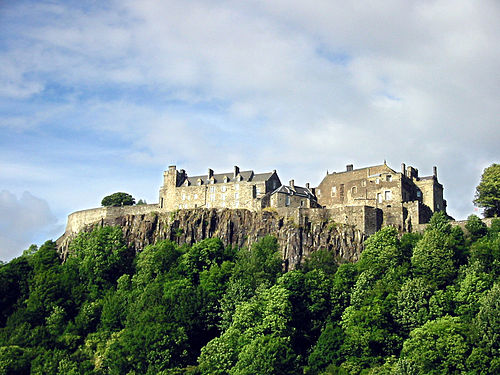
The rock beneath your feet is quartz-dolerite around 350 million years old, and whoever held it held Scotland. Stirling Castle guarded what was, until the 1890s, the lowest crossing of the River Forth, so armies had to come this way. Steep cliffs protect it on three sides.
Most of the great buildings you see date from the fifteenth and sixteenth centuries, when the castle was as much a royal palace as a fortress. Mary, Queen of Scots, was crowned here in 1542, and other monarchs were born or died within these walls. The castle endured at least eight sieges; the last came in 1746, when Bonnie Prince Charlie tried and failed to take it.
Walk the outer defences facing the town, added in the early eighteenth century, and look down on the whole Forth valley.
This story is compiled from Wikipedia and other open sources; dates and numbers are checked against the source. The text is shared under the CC BY-SA 4.0 licence. Source ↗
Hear this story on the spot, in a natural voice
On Sightlore, the story of Stirling Castle is narrated in a natural voice in 5 languages. When you arrive, say "I'm here" and get your passport stamp.
17 more stories from Stirling in the app
More highlights in Stirling
- Loch KatrineLoch Katrine is a freshwater loch in the Trossachs area of the Scottish Highlands, east of Loch Lomond within the Stirling council area.
- Inchmahome PrioryInchmahome Priory is situated on Inchmahome, the largest of three islands in the centre of the Lake of Menteith, close to Aberfoyle, Scotland. The name "Inchmahome" comes from the Gaelic Innis MoCholmaig, meaning island of St Colmaig.
- Church of the Holy Rude, StirlingThe Church of the Holy Rude is the medieval parish church of Stirling, Scotland. It is named after the Holy Rood, a relic of the True Cross on which Jesus was crucified.
- Doune CastleDoune Castle is a medieval stronghold near the village of Doune, in the Stirling council area of central Scotland and the historic county of Perthshire. The castle is sited on a wooded bend where the Ardoch Burn flows into the River Teith.
- Argyll's LodgingArgyll's Lodging is a 17th-century town-house in the Renaissance style, situated below Stirling Castle in Stirling, Scotland. It was a residence of William Alexander, 1st Earl of Stirling and later the Earls of Argyll.
- Wallace MonumentThe National Wallace Monument (generally known as the Wallace Monument) is a 67 m (220 ft) tower on the shoulder of the Abbey Craig, a hilltop overlooking Stirling in Scotland.