Poland
Things to do in Wrocław
34 places33 stories3 routes
Sightlore has 34 places to explore in Wrocław, and 33 of them come with a 60-second story in 5 languages. Point your camera at a landmark to learn its name and story, and earn points and badges at the places you actually visit.
Wrocław's must-sees
The city's most important places. In the app you see how many you've visited and earn a badge when you've seen them all.
- 1

Wrocław University Botanical Garden
The Botanical Garden of the University of Wrocław is a botanical garden in Wrocław founded in 1811 in the area of Ostrów Tumski. The garden was established for medical students at the local university.
- 2

Racławice Panorama
The Racławice Panorama is a monumental (15 × 114 meter) cycloramic painting depicting the Battle of Racławice, during the Kościuszko Uprising. It is located in Wrocław, Poland.
- 3

Pergola in Wroclaw
Early 20th-century half-elliptical pergola around a fountain pond beside the Centennial Hall.
- 4

Collegium Maximum in Wrocław
Baroque main building of the University of Wrocław, begun in 1728 on the site of the old Piast castle.
- 5

Wrocław Town Hall
The Old Town Hall of Wrocław is a building at the centre of the city's Market Square (rynek).
- 6

Museum of the University of Wrocław
The Museum of the University of Wrocław is a museum in Wrocław (Poland) displaying many of the historical objects of the University of Wrocław.
- 7

Pillory in Wrocław
Faithful copy of the 1492 pillory on the Market Square.
- 8

Tumski Bridge
The Tumski Bridge is a steel bridge over the northern branch of the Oder in Wrocław. Constructed in 1889, it replaced an old wooden bridge to connect the Cathedral Island with the Sand Island. The bridge is open to pedestrians only.
- 9

White Stork Synagogue
The White Stork Synagogue is a Conservative Jewish congregation and synagogue, located in Wrocław, in the Lower Silesian Voivodeship of Poland.
- 10

Centennial Hall
The Centennial Hall; German: Jahrhunderthalle), formerly named People's Hall (Hala Ludowa), is a historic building in Wrocław, Poland. It was constructed according to the plans of architect Max Berg in 1911–1913.
Read its story →
Discovery routes in Wrocław
Visit the stops in any order and tap "Check in" at each one; finish the route to earn points and its own badge.
Wrocław: the Market Square and University
From the Opera to the Four Denominations District and the White Stork Synagogue, from Salt Square to the Market Square: the Town Hall, the Fredro Monument, St Elizabeth's and St Mary Magdalene, the Old Butchers' Stalls, and the Baroque university with its Aula Leopoldina.
Wrocław: Cathedral Island
From the Market Hall to Sand Island, across Tumski Bridge to Cathedral Island, the oldest part of the city: Holy Cross Church, the cathedral, St Giles, the Botanical Garden, then the National Museum and the Racławice Panorama.
Wrocław: Centennial Hall and Szczytnicki Park
The UNESCO-listed Centennial Hall, the Iglica, the Four Domes Pavilion and the Pergola; then the Japanese Garden, Szczytnicki Park and the oldest zoo in Poland.
Places to visit
Historic sites

Wrocław Opera
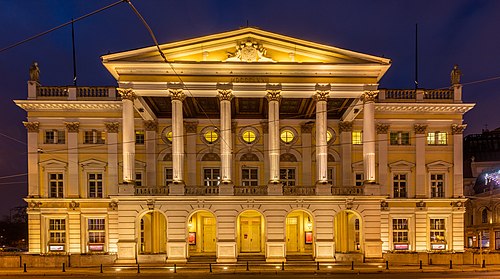
The Wrocław Opera is an opera company and opera house in the Old Town of Wrocław, Poland, opened in 1841.

Four Denominations District
The Four Denominations District is an area of the Old Town in Wrocław, Poland, between Kazimierza Wielkiego, Św. Antoniego, Pawła Włodkowica and Św. Mikołaja streets.

Salt Market Square
The Salt Square is a medieval market square in Wrocław, Poland. It is one of the three historic market squares in the city's old town, next to the Market Square and the New Market Square.

The Market Square
The Market Square is a medieval market square located in Wrocław, Poland. The square is rectangular with the dimensions 213 by 178 metres (699 ft × 584 ft) and serves as a pedestrian zone.

Old Butchers' Stalls
Historic lane of the old butchers' stalls in the Old Town.
Collegium Maximum in Wrocław
Baroque main building of the University of Wrocław, begun in 1728 on the site of the old Piast castle.

Aula Leopoldina
The magnificent Baroque ceremonial hall of the University of Wrocław.
Tumski Bridge
The Tumski Bridge is a steel bridge over the northern branch of the Oder in Wrocław. Constructed in 1889, it replaced an old wooden bridge to connect the Cathedral Island with the Sand Island. The bridge is open to pedestrians only.

Cathedral Island
The Cathedral Island is the oldest part of the city of Wrocław in south-western Poland. It was formerly an island between branches of the Oder River. Today it is the city's popular tourist destination.
Museums
Wrocław Town Hall
The Old Town Hall of Wrocław is a building at the centre of the city's Market Square (rynek).
Museum of the University of Wrocław
The Museum of the University of Wrocław is a museum in Wrocław (Poland) displaying many of the historical objects of the University of Wrocław.

National Museum in Wrocław
The National Museum in Wrocław, established 28 March 1947 and officially inaugurated on 11 July 1948, is one of Poland's main branches of the National Museum system.
Racławice Panorama
The Racławice Panorama is a monumental (15 × 114 meter) cycloramic painting depicting the Battle of Racławice, during the Kościuszko Uprising. It is located in Wrocław, Poland.

Four Domes Pavilion, Wrocław
Four Domes Pavilion is a pavilion built at the beginning of the 20th century on the exhibition grounds in the eastern part of Wrocław.

Old Jewish Cemetery
The Old Jewish Cemetery is a historic necropolis-museum situated on 37/39 Ślężna Street, in the southern part of Wrocław (formerly Breslau), Poland.
Places of worship

St. Elizabeth’s Church Wrocław
St. Elizabeth's Church is a Brick Gothic church of the Catholic Third Order of Saint Francis located in Wrocław, Poland.

St. Mary Magdalene Church, Wrocław
Cathedral of St. Mary Magdalene in Wrocław, Poland, is a gothic church located between Szewska and Łaciarska street close to the central market square, established in the 13th century.

University Church of the Blessed Name of Jesus in Wrocław
Baroque church of the University of Wrocław in the northern Old Town.

Church of St. Vincent
The Cathedral of St. Vincent and St. James (Polish: Katedra św.

Church of Our Lady on the Sand in Wrocław
The Church of St. Mary on the Sand is a Catholic church in Wrocław, in Silesia, located on the Sand Island, in the Oder River, in the heart of the city. Founded in the 12th century, it is one of the oldest Gothic churches in the country.

Collegiate Church of the Holy Cross and St. Bartholomew in Wrocław
Collegiate Church of the Holy Cross and St. Bartholomew in Wrocław, Poland, is a two-storey brick Gothic collegiate church on the Ostrów Tumski (Cathedral Island), considered the second most important Roman Catholic church in Wrocław.

Wrocław Cathedral
The St. John the Baptist Archcathedral (Polish: Archikatedra św. Jana Chrzciciela, German: Breslauer Dom, Kathedrale St.

Saint Giles' church
The oldest surviving building in Wrocław, from the first half of the 13th century.
Monuments
White Stork Synagogue
The White Stork Synagogue is a Conservative Jewish congregation and synagogue, located in Wrocław, in the Lower Silesian Voivodeship of Poland.
Pillory in Wrocław
Faithful copy of the 1492 pillory on the Market Square.

Aleksander Fredro Monument in Wrocław
The Aleksander Fredro Monument is a bronze statue located in Wrocław, Poland dedicated to Polish Romantic-era poet, playwright and author Aleksander Fredro.

Wrocław Market Hall
Wrocław Market Hall is a food hall in central Wrocław, Poland. Designed by Richard Plüddemann, it was built between 1906 and 1908 as the Breslauer Markthalle Nr 1, when the city was part of German Empire.
Centennial Hall
The Centennial Hall; German: Jahrhunderthalle), formerly named People's Hall (Hala Ludowa), is a historic building in Wrocław, Poland. It was constructed according to the plans of architect Max Berg in 1911–1913.

Iglica
Iglica is a needle-like monument in Wrocław, Poland. It was built in 1948 and was 106 metres tall. Today, after renovation, the top ten metres have been removed and it is now 90 metres tall.
Pergola in Wroclaw
Early 20th-century half-elliptical pergola around a fountain pond beside the Centennial Hall.
Nature
Wrocław University Botanical Garden
The Botanical Garden of the University of Wrocław is a botanical garden in Wrocław founded in 1811 in the area of Ostrów Tumski. The garden was established for medical students at the local university.

Japanese Garden in Wrocław
The Wrocław Japanese Garden is located in the Śródmieście district of Wrocław, Poland, in the boundaries of Szczytnicki Park, adjacent to the UNESCO-listed Centennial Hall.

Szczytnicki Park
Szczytnicki Park in Wrocław, Poland is located to the east of Grunwald Square and the old Oder river, and covers approximately 10 square kilometres of land.

Wrocław Zoological Garden
The Wrocław Zoological Garden, known simply as the Wrocław Zoo, is a zoo on Wróblewski Street in Wrocław, Poland.
Explore Wrocław with your camera
Hear the stories on the spot, complete routes, collect badges. Sightlore is coming soon to the App Store.